


yoga with jeff
Lifestyle • Fitness & Health • Books
Based in household yoga practices of more than 40 years, Jeff’s yoga work will include group sessions, and additional content not focused exclusively on posture. That additional content will include 9 Minutes or LESS, and will include THE PRANA PROJECT. Jeff will share therapeutic, maintenance, and training that alternate between the Playful (Lila) and the Heroic (Vira). Look for an occasional Book Review, Interview, Creative Adventure, or Personal Note in realms practical and imaginative.
Interested? Want to learn more about the community?

Learn more first
Dukha, Part Three

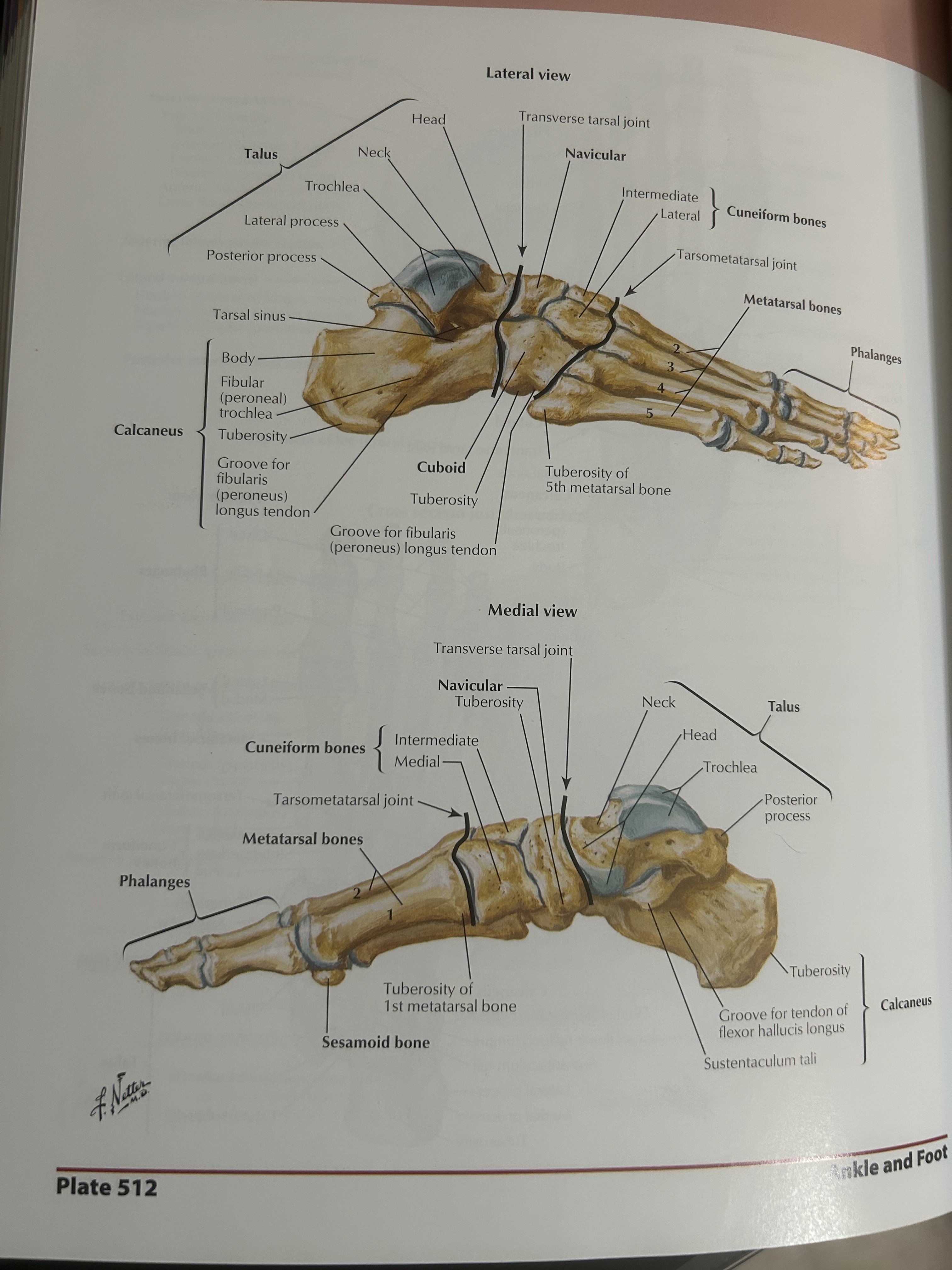
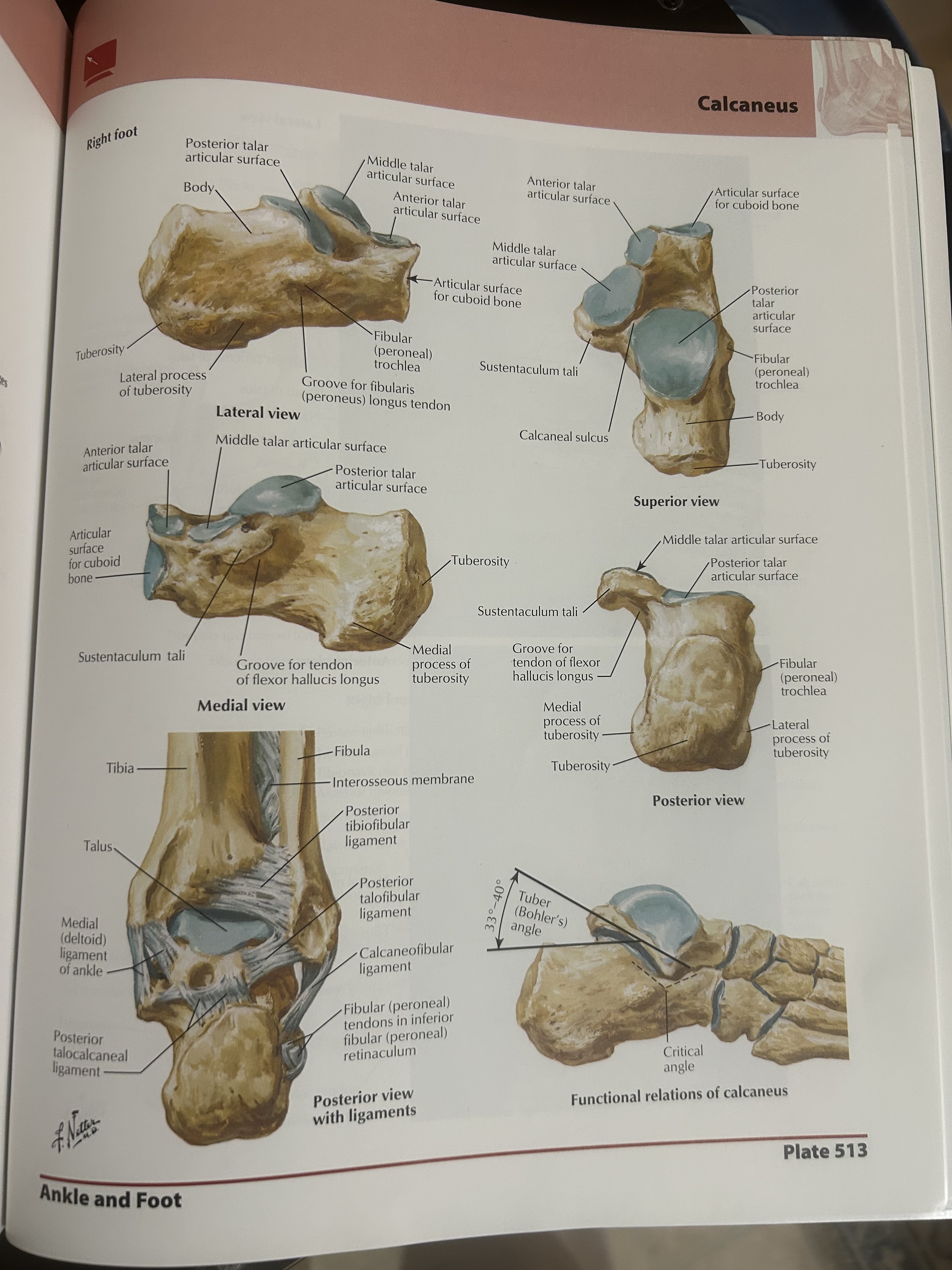
Before you begin this update, please check the two previous entries with images. Anatomical details.

I break the entries into pieces because I have lost afternoons of work when the LOCALS platform went blank, certainly due to my own fault. So, to assure that I complete entries without loss, I upload in chunks. I appreciate you following these ongoing entries.

The images from the previous entry include detailed images of the skeleton with isolated anatomical closeups of the spinal vertebrae and ribs. The prior entries introduced Dukha as a concept and dukha in a recent experience where my rib cage splatted back into the mat. Linda the trauma massage therapist helped talk me back through the experience so that we might understand what needed to be re-stored / palpated into proper position. That is the fundamental starting point.

She had me visualize the impact in slow motion, how the force localized at the 4th rib of the chest, how the presssure of that force “splatted” the contents of my thoracic cavity — right lung, attachments of the diaphragm of the right side, and even just below the diaphragm into the abdominal cavity and upper sections of liver. Splat. Do you know what I mean? Something of a “contained splash” where a force compacts centrally and pushes out the side contents. Linda had me think in terms of a visual dynamic, a contained volume that receives a powerful local pressure.

Linda used her fingers to re-assert the diaphragm under the ribs, to lift the liver up. Her fingers “reminded” the tisssue where they belonged. She gently identified intercostal muscles, pec major and pectoralis minor to realign and remind them of their functional positions.. They were not detached but they were bruised and affected by the head spear impact.

Human muscle and connective tissue of fascia can be “displaced” or bruised not unlike an apple or a banana or mango. Of course, living human tissue is much more resilient and can respond in healing if given the right conditions.

To know the landscape of the damage with an intimate awareness based in visual image is the start of “right conditions.” Pratyahara. To visually imagine the force moving in the body allows healing. The pratyahara identifies the internal landscape and clarifies our strategy to “undo” impact and restore function. If nothing is actually broken, detached, cracked, split open or hemorrhaged, then bruises can heal. Sometimes it takes weeks, sometimes days, sometimes less.

In my case linda helped me to see the chest as safe, as bruised but not broken. I began to feel muscles moving into their proper place. When departing Linda’s studio, I knew the dukha moved in the proper direction.

Dukha/ Not so fast
Sleep remained a problem. Two days later the problem had returned and become clear. The impact’s force had moved through my chest into my back. I could move the arm but could not hold or sustain strength. To move the arm toward the heart’s median plane — adduction, and to move the arm open and away from the median plane —abduction, neither position sustained. With yoga postures and movement, with breath and pratyahara, I traced the line of weakness to the 5th thoracic rib beneath the shoulder blade on the right side of my back. A weakness and pain arose from the muscles there. They seemed compromised by lack of support. I traced the 5th rib toward the spine.

I lay on my back, tucked my knees, gripped a hand on each shin, moved on the floor. I rocked and pressured the upper back region into the floor with breath. I sensed the 5th rib’s connection to the 5th thoracic vertebra. There, the rib surface connects into the facets of the vertebra, held by bands of ligament. There. It was loose. The rib’s ligament connection to the facets of the 5th vertebra, not secure. The source of the problem became clear. The muscles may have been bruised but the rib’s normal attachment site did not hold. Instead of a the rib as an anchor, the rib twisted when the muscles contracted. The muscles attached to that 5th rib could perform their functions. The muscles could contract, but their anchored rib turned. So instead of holding solid from the spine, that 5th rib had gotten banged loose. Aha. As I acted upon that visual image, the pain, the dukha edged softer.

Path of Healing / Sukha
The solution has been to visit Homer several times over consecutive days. Each day is a renewal and a “reset” of the region. The ligament feels “sticky.” With pranic support up from the lumbar spine as well as pranic support down from the neck, Homer’s chiropractic hands remind my body how to hold the vertebral alignment so the rib “drops” into place.

I focus on maintaining the spinal alignment with breath. That alignment reminds the rib. I make no extra demands of my arm. I move the arm consciously with full conscious breath delivery and connection. I move the arm gently but not gingerly. With conscious attention I find the effortless effort. I know the rib is healing quickly but at its own pace.

Tomorrow, I might be able to record a video of light practice of renewal — Sukshma Vayaam variations. Will keep you posted.

Interested? Want to learn more about the community?

Learn more first
What else you may like…
Videos
Posts
Articles
Test for Neuropathy video 1

test to transfer video #1

00:04:39
10 One Minute Moves for Hands, Arms, Shoulders, 1

We begin today from a standing and neutral position. We observe the easy and full breath cycle of exhale and inhale. Place attention on the present moment of the breath cycle as you stand. This is the ground work for the next nine videos.

The videos are progressive so do not skip ahead. This is video #1 of ten, each video about one minute except #10. That final video is a little experiment in observation.

00:01:11
Salute, Wednesday, 7 January 2025

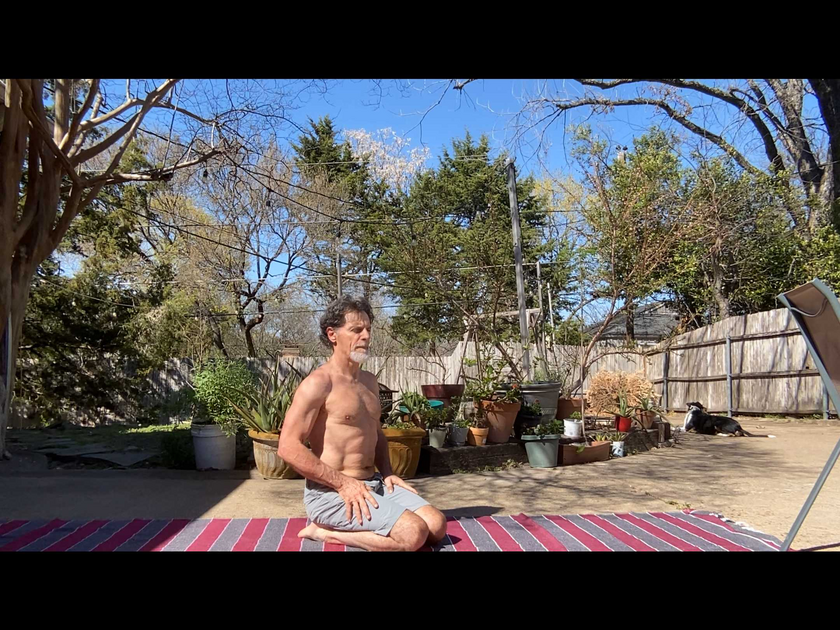
I’ve already made a practice this morning, a practice which you can view in any of the videos over the past two years. If you have the preliminary practices, then you can add on. Here is one Surya Namaskar variation, a Salute to the Sun.

00:21:37
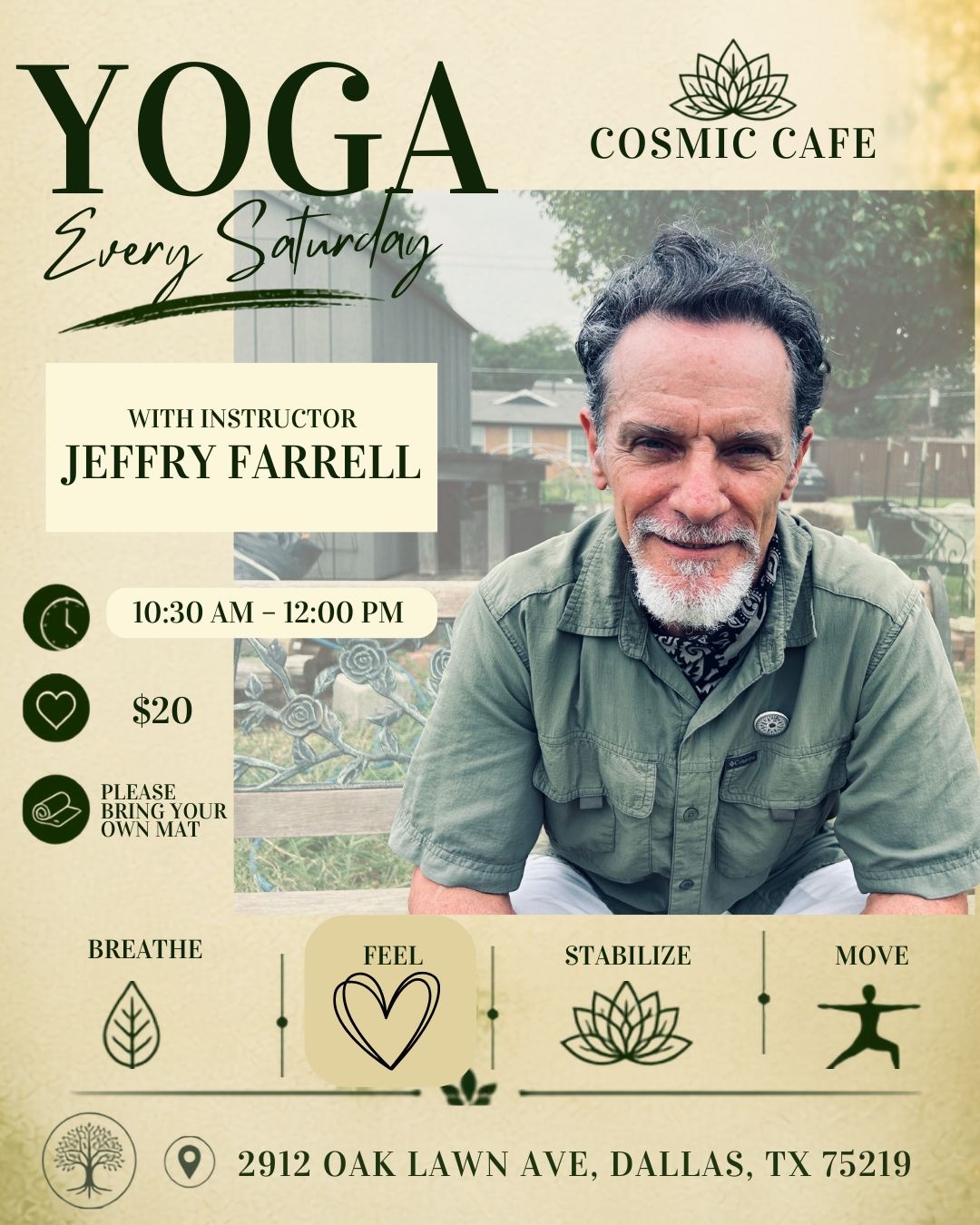
Group class at Cosmic Cafe!

Join Jeff at Cosmic Cafe on Saturday, 10:30 - Noon, for a group yoga class. Space is limited. Bring your mat. Arrive early. $20 (cash preferred). RSVP’s help Jeff and the restaurant prepare. You can comment here or text Jeff to let him know you’re coming.

post photo preview
Addressing a Broken Heel

In a rehearsal for an original performance at the Hip Povcket Theatre in Fort Worth, I broke my heel bone called the calcaneous. I had arrived 30 minutes late because a wreck on the highway had stopped traffic. Implicitly, performance requires an extra-daily guidance of energy. That guidance includes re-connecting with basic principles of breath, stillness, and centered movement. However, in my effort to "catch up" I literally leaped into a
"scene" and fell.

You know the feelings that arise from trying to fit into a social or business setting when you arrive late, particularly when timing is significant. Stage timing is significant. Well, you can't ever "catch up" but we can fit in.

I leaped into a cartwheel which my character was scripted to fall. Because I had not centered, because I skipped the basics, didn't breathe consciously, etc. I fell wrong and slammed my heel on the stage floor. Instant karma. Pain? Oh. Worse was the instant knowledge that the heel hit was not ...

Vertigo:

Here is a simple breath practice I texted to one of my people who has been experiencing vertigo.

Often vertigo is a localized problem of the inner ear but it can be totally unsettling. Not just dizziness but an entire disruption of visual and spatial orientation, a spinning room, an incapacity to focus the eyes, even to the point of nausea and total incapacity.

When the vertigo stops, you can remain dis-oriented and exhausted. The breath practice below is to re-orient and stabilize your “normal” resting position.

First, stop the vertigo. The following three short videos help to stop the vertigo.

1) https://www.google.com/search?q=epley+move+for+vertigo&ie=UTF-8&oe=UTF-8&hl=en-us&client=safari#fpstate=ive&vld=cid:60b6eb88,vid:F_2GpR4HtkY,st:0

2) https://youtu.be/Wez9SZJ7ABs?is=aqlnJGsbOVvssZVV

3) https://www.youtube.com/watch?v=qS-OHrOCa7U?is=qQE1YE1VySeaDDSd

Second, rest. Focus on your breath. Be still. Here is a breath practice to help you be still:

a) Place ...

post photo preview
HATHA YOGA
If you came here from my email invitation, then take ten bucks off your Saturday group class!

Our 21st century culture has received yoga into its daily routines.  There are probably more yoga teachers today than there are students.  Me, I start from scratch everyday and invite you to join me.

Today, I ask what is Hatha Yoga?

The direct translation of Yoga is to yoke, to join together.  Our practice is to join the Breath, the Attention, and the Body.  To understand that the body is a vessel is a Hatha practice.  What does that vessel contain?  What is kept in this vessel that is the body?  Only Life Force energy, known as Prana.  And further, that Life Force energy makes the vessel itself.  The body is an expression of Prana.  

The Sanskrit word hatha holds the meaning of ha and tha.  Ha is the sound of the Prana as a "solar" force that channels through and into the body through what is known as pingala.  Tha is the Pranic sound of the mental energy that channels through and into the mind through what is known as ida.  Ida and Pingala, left and right, are channels of Life Force that run through the body and allow all its operations.  The management of these two qualities of Life Force, the vital physical force, and the mental force, that is the aim and focus of Hatha Yoga.  

We can observe the body in stillness and in movement.  We turn our attention to the breathing and notice the four phases.  1. The exhale empties the vessel.  2. The vessel is empty. 3. The inhale fills the vessel.  4. The vessel is full.  Repeat in stilllness. Repeat with movement.  

In our practice of stillness and movement, we can ask questions about the breath and how it feels, how it works in the body.  Where is the strength through all four phases? Where is the balance? Where do I sense dilation? Contraction?  Is right and left equal?  How to adjust ourselves so that the breath and the channels right and left find balance and full function? Harmony? The body is an observable entity.  The mind is mobile and fluid and can dance like a crazed monkey. So, like Odysseus, we tie our attention to the mast of the body using our breath.   Then we can observe the mental energy's thought forms.  

Kumar used to say, "Observe your thought-forms."  I had no idea what he meant.  Yet, as I practice over the years, the body anchors me so that the functions of mind become more clear.  Thought-forms arise and blend, fall away, and rise again.  With functions of mind, more of our experience finds clarity, in both the world of form and the subtle world of the formless. With a mind we move and work.  We socialize in groups, form partners. We find time alone.

Thank you for reading these impromptu notes.  I may have opened more questions than I have answered but this Hatha practice is rich and a foundation for other styles and forms.

Here are some questions that come to mind now (which is beyond the scope of this entry) as they relate to the note  above:

1) Are there different types of Prana?  

2) Are there different styles and disciplines of yoga?  What makes them similar and what distinguishes them?  What are names of styles and disciplines?  

3) As regards Hatha -- What are these channels of Life Force? the nadi?  the ida (left) and the pingala (right)?

4) How can we tell if we are balanced?  

5) What does the ida do? what does the pingala do?

6) Must we even think of these at all or can we just do the movements? the asanas?

7) where does meditation fit in?


Ok, that's all I can enter today.  Let's pause on all those questions.  Perhaps the practice itself can answer some of them directly, so come join us at the Cosmic Cafe, 2912 Oak Lawn.  Saturdays.  10:30 - noon.  $20 cash.  


Pls comment . . . . 


Read full Article
Here is a Salute to the Sun version whose purpose is to carry Shtira
Surya Namaskar Lila and Vira

It's really a video not an article. . . .  And it is the captured video of one Salute sequence originating with one side.

Read full Article
post photo preview
Elements of Practice
March 11, 2023

Read full Article
Available on mobile and TV devices
google store google store app store app store
google store google store app tv store app tv store amazon store amazon store roku store roku store
Powered by Locals